

How to Hang a Finished Paint by Numbers Without a Frame

Yes, you can hang a finished paint by numbers without a frame at all. Frameless is easy, cheaper than custom framing, and it often looks more modern on the wall.
Two questions pick your method. First, how damage-free does it need to be? Are you a renter who can't put holes in the wall? Second, is your canvas a flat sheet or already stretched over wooden bars? Answer those and the right method falls out fast. The hardware below lives in our framing and hanging accessories collection if you want to grab it in one place.
Key Takeaways
- Frameless works. Methods run from no-damage (poster hangers, removable strips, washi tape) to permanent (mounting on a panel).
- Four pairs of small picture-hanging strips hold up to about 5 lb and peel off without wall damage (3M Command). That covers most flat canvas sheets.
- Flat sheet versus stretched changes everything. Sheets want backing, hangers, or tape; stretched canvases can take D-rings and wire.
- Do two things before you hang: flatten any wrinkles and varnish the surface.
- Insider tip: paint the raw canvas edges before any direct-to-wall method so no white margin shows.
What should you do before you hang anything?
In our experience helping painters finish their pieces, two prep steps make every method below look better, and they take ten minutes. However, skip them and even the cleanest hanger shows wrinkles and a dull surface.
First, flatten the canvas. A sheet that's been rolled in a tube holds its curl, and that curl telegraphs through every frameless mount. Therefore, we walk through ironing and weighting in how to flatten a wrinkled canvas, so do that first and come back here.
Second, seal the surface with a varnish once the paint is fully cured. Varnish protects the finish, evens out the sheen, and makes colors pop on the wall. The full routine lives in how to get professional results. We keep coverage distinct here. This section only flags that you do these first, then hang.
Which hanging method is right for you?
Here's the decision hub. First, scan it, pick a row, then read that method's how-to below. Notably, the biggest split is flat sheet versus stretched, with damage level a close second for renters.
| Method | Best for | Damage level | Difficulty |
|---|---|---|---|
| Magnetic poster hanger | Flat sheet | None | Easy |
| Removable picture-hanging strips | Flat sheet or light board | None | Easy |
| Washi tape | Flat sheet | None | Easy |
| Binder clips | Flat sheet, temporary | Minimal (one nail) | Easy |
| Foam board mount | Flat sheet | None to minimal | Medium |
| Hardboard or birch panel | Flat sheet, gallery look | Minimal | Medium |
| Stretch over a DIY wooden frame | Flat sheet → gallery wrap | Minimal (one hook) | Medium |
| Thumbtacks, direct to wall | Flat sheet, casual | Small holes | Easy |
Damage-free and renter-friendly: how do you hang it without holes?

This is the no-damage tier, built for flat sheets and light canvases. Each method below is quick, and none of them needs a drill. However, one note before you start: the strip and clip routes leave the raw canvas edges visible, so paint or tape those first.
Magnetic poster hangers
A magnetic poster hanger is a pair of wooden strips with magnets inside that clamp a sheet along its top and bottom edges. The bottom strip's weight keeps the canvas flat and straight, and you hang the whole thing from a built-in cord. As a result, it's the quickest no-damage option and a favorite for renters. One small heads-up we hear from customers: bare wood strips can be stained darker if you want them to match your trim.
Removable picture-hanging strips
Adhesive strips are fast and come off clean. First, press them to a smooth, dust-free wall, then press the canvas or its backing on. We stock sticky picture hanging strips sized for paint by numbers sheets. However, confirm the weight rating before you trust them. More on that in the next section.
Washi tape
Washi tape is the most casual route and the most forgiving on walls. For instance, tape the canvas flat at the corners, or run a decorative border around all four edges. Meanwhile, that border doubles as a way to hide unfinished white margins, which makes it a clever fix and a frame in one.
Binder clips
For a temporary or rotating display, clip a couple of binder clips along the top edge and hang them from a small nail or hook. However, it's casual and shows the raw edges. As a result, this one suits a studio wall or a gallery of works in progress more than a living room centerpiece.
How much weight will adhesive strips actually hold?
This is the section that keeps you from picking a method that fails at 2 a.m. The numbers come straight from the maker, so you can match the strip size to your canvas with confidence.
For example, per 3M Command, four pairs of small picture-hanging strips hold up to about 5 lb and hang frames up to 18×24 inches. Meanwhile, larger sizes climb to roughly 16 to 20 lb. They grip smooth painted walls, finished wood, glass, and tile, and they remove without damage when you stretch the tab straight down slowly rather than pulling out.
The practical takeaway: most flat paint by numbers sheets weigh well under the small-strip limit, so a few pairs are plenty. In contrast, a heavier stretched canvas on wooden bars is a different animal: step up to a larger strip size or switch to a hook-based method instead.
Sturdier and cleaner: mounting a flat sheet to a backing
If you want a crisp, modern, lasts-for-years look, mount the sheet to a rigid backing. As a result, flatness improves instantly, and the panel does double duty as protection. In fact, conservators rely on the same idea (Canadian Conservation Institute). They fit canvas paintings with backing boards so the reverse can't be knocked or punctured. Therefore, your finished kit gets the same benefit.
Foam board or cardboard
This is the lightest option. First, cut the board to your exact canvas size, spray it evenly with a strong adhesive, then lay the canvas down and smooth it from the center outward to push out air bubbles. As a result, a light board this thin hangs cleanly on a couple of removable strips.
Hardboard, masonite, or birch panel
For a rigid, gallery-like result, spray-mount the sheet to hardboard or a birch panel. Notably, the extra stiffness reads as quality on the wall. Then hang it with a sawtooth hanger or a D-ring screwed into the panel, or prop it on a shelf inside a floating frame.
Why a rigid backing helps
Beyond looks, a backing locks the canvas dead flat, shields the painted surface from dents, and gives you a clean edge to mount hardware on. In short, it turns a floppy sheet into something that behaves like a real panel painting.
The gallery-wrap trick: stretch your finished canvas over wooden bars
This is the most finished, frameless-but-framed look there is: a true gallery wrap. A gallery wrap is a canvas stretched around the sides of a wooden frame and fastened on the back, so no separate frame shows. And you don't need to buy a blank pre-stretched canvas to pull it off.
Instead, use our DIY wooden frame, which is a set of stretcher bars. Stretcher bars are the slim wooden lengths that lock together into a rigid rectangle for the canvas to wrap around. Assemble the bars to match your canvas size, lay your painted sheet face-down, then fold it around the bars and staple it to the back. Meanwhile, pull each side taut as you go so the front stays drum-flat with crisp corners. As a result, the piece hangs straight off a single hook with no separate frame at all.
This works best when you started on a flat sheet, since you need the extra margin to wrap. However, if you're still deciding between formats before you buy a kit, that's a different question. See rolled or stretched canvas, which is right for you. That post helps you choose up front; this one repurposes a finished sheet.
Going direct to the wall: the raw-edge trick
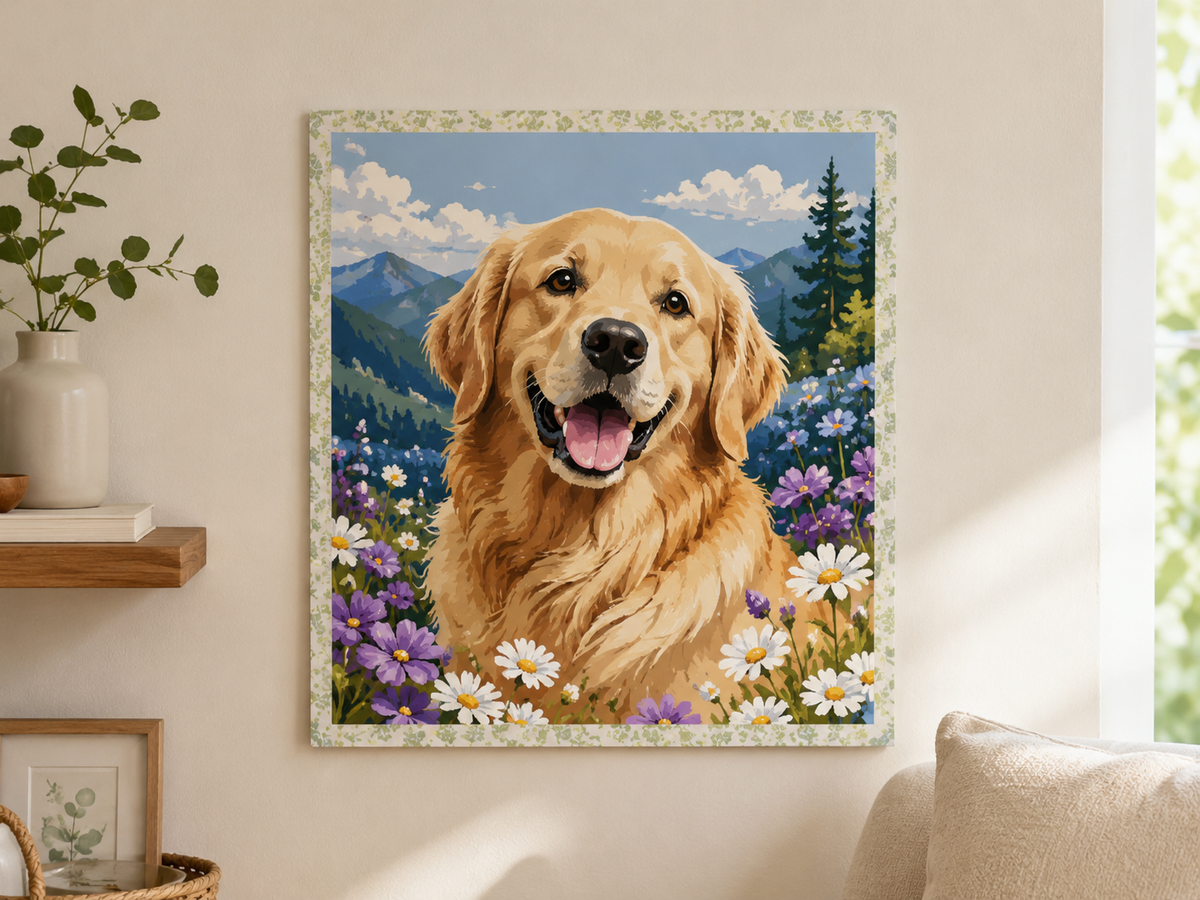
The fastest, most casual route is thumbtacks or adhesive strips straight onto the canvas. For instance, it takes thirty seconds, and it's perfect for a dorm, a studio, or a spot you'll rearrange often.
The trick that makes it look intentional rather than improvised is simple: paint the raw canvas edges first. Specifically, brush leftover acrylic along all four sides so no white margin peeks out, or border them with washi tape for the same effect. In our experience, the unstretched edges of our Wrinkle-Free Canvas stay flat and even, which makes that painted border read clean instead of ragged.
How we make hanging a paint by numbers without a frame easier
A few things in our kits quietly remove steps from this whole process. Our Wrinkle-Free Canvas means far less flattening before you mount, so a sheet is closer to wall-ready out of the box.
Our High-Opacity Paint gives clean, fully covered edges for the raw-edge trick, and our acrylic varnish plus the framing add-ons in our accessories collection handle the seal-and-hang steps in one stop. Plus, if the finished piece is a gift, our gift-ready packaging gets it there looking the part. You can read more on our about us page.
Reviewed by the Davincified editorial team. Hung yours a way we didn't cover? Contact us. We keep this guide updated as new methods come in from painters.
Frequently Asked Questions
Yes, easily. Use a magnetic poster hanger or adhesive strips for a flat sheet, mount it to foam board or a panel for a rigid look, or stretch it over wooden bars for a gallery wrap. Pick by how damage-free it needs to be and whether your canvas is a flat sheet or already stretched.
No, when removed correctly. Per 3M Command, the strips peel off smooth walls, finished wood, glass, and tile without damage if you stretch the tab straight down slowly rather than pulling outward. Press them only to a clean, dust-free surface so they grip fully in the first place.
Four pairs of small picture-hanging strips hold up to about 5 lb and hang frames to 18×24 inches, while larger sizes reach roughly 16 to 20 lb (3M Command). Most flat paint by numbers sheets fall well under the small limit. A heavier stretched canvas needs a larger size or a hook.
It's strongly recommended once the paint has fully cured. Varnish protects the surface, evens the sheen, and makes colors pop on the wall. Wait until the film is hard, not just touch-dry, then apply a thin coat. Our pro-results guide covers timing and technique so the finish stays even.
Two quick fixes. Paint the four edges with leftover acrylic so the color wraps around and no white shows, or run decorative washi tape along the borders to frame them. Both take minutes and make a frameless, direct-to-wall hang look intentional instead of unfinished.


